For manufacturers and processors, a quality management system should be more than a set of procedures and a certificate on the wall. When implemented properly, it can become a practical tool for controlling processes, reducing risk and driving continual improvement.
For many businesses, the conversation around ISO certification begins with a customer requirement.
- A major customer requires ISO 9001.
- A tender requires certification.
- A new market requires a recognised management system.
- A food business needs to demonstrate robust food-safety controls.
The immediate objective becomes certification. But there is a more important question:
What happens after the certificate is issued?
A management system should not exist simply to satisfy an auditor. It should help management understand how the business operates, where risks exist, where processes can fail and where improvements can be made.
That is where the real value lies.
Certification is the outcome – not the objective
Standards such as ISO 9001 provide a structured framework for managing quality. Other standards address different areas of business risk and performance, including environmental management, occupational health and safety and food safety.
The specific requirements differ, but the underlying principle is similar:
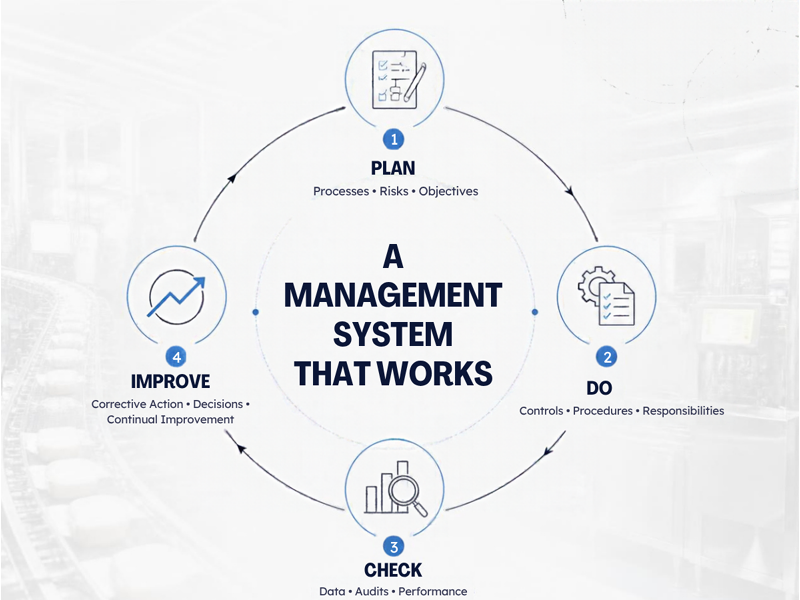
Understand the business. Control what matters. Measure performance. Address problems. Improve.
Certification provides independent confirmation that the organisation’s management system meets the applicable requirements.
But certification alone does not guarantee that a business has good processes.
A company can have beautifully presented procedures and still have employees who do not follow them.
It can have completed forms without using the information contained in them.
It can conduct audits without addressing the underlying causes of recurring problems.
The difference between a system that exists and a system that works is implementation.
The danger of “paper compliance”
One of the biggest challenges with management systems is allowing the documentation to become the system.
When that happens, employees can begin to see quality as an administrative function rather than part of their everyday responsibilities.
Procedures are written because they are required.
Records are completed because someone needs to see them.
Internal audits are conducted because the calendar says they are due.
Corrective actions are closed because the audit finding needs to be closed.
The business may technically have a management system, but it is not necessarily getting the value it should.
A practical system should work the other way around.
The business identifies what needs to be controlled, determines how it will control it, collects useful information and uses that information to make better decisions.
The documentation should support the process – not become the process.
Data is one of the most valuable parts of a management system
Every processing business generates information.
- Customer complaints.
- Production results.
- Non-conformities.
- Equipment failures.
- Maintenance records.
- Supplier performance.
- Audit findings.
- Waste.
- Rejections.
- Incidents.
- Corrective actions.
- Customer feedback.
These are not simply records that need to be filed. They are signals.
When information is properly organised and reviewed, patterns begin to emerge. A recurring customer complaint may indicate a process weakness. Repeated equipment failures may point to a maintenance issue. Supplier problems may be affecting production consistency.
A series of minor non-conformities may reveal a larger systemic problem. This is where a management system becomes useful to management. It turns individual events into information that can be analysed and acted upon.
Risk management should be part of everyday thinking
Modern management systems increasingly place emphasis on risk-based thinking.
For a processor, this should not mean creating another complicated risk register that nobody uses. Risk management should be connected to the actual operation.
- Where could the process fail?
- What could cause the failure?
- What would the consequence be?
- What controls are already in place?
- How do we know those controls are working?
- What needs to change?
The same thinking can be applied to quality, environmental impact, occupational health and safety, food safety, suppliers, equipment and operational processes.
The objective is not to eliminate every possible risk. It is to understand the risks that matter and manage them systematically.
Integrated systems can make sense for growing businesses
A business may initially focus on one standard because a customer requires it. As the organisation grows, however, additional requirements may emerge.
A manufacturing or processing business may need to address quality, environmental management and occupational health and safety. A food-related business may have additional food-safety requirements.
Managing each system as a completely separate exercise can create unnecessary duplication. Where appropriate, management systems can be integrated so that common processes – such as document control, internal audits, corrective action, management review and continual improvement – support multiple requirements. This can make the system easier to manage and more useful to the organisation.
The best management system is one people can actually use
Ultimately, a management system belongs to the business – not to the consultant and not to the auditor.
Employees need to understand what is expected of them. Managers need meaningful information. Processes need to reflect what actually happens on the production floor. Records need to provide useful evidence. Problems need to lead to corrective action. And management needs to use the information generated by the system to make decisions.
When these elements work together, certification becomes more than a compliance exercise. It becomes a framework for running the business more consistently.
Building a system around the business
There is no value in forcing a company’s operations into an unnecessarily complicated management system simply because that is how another organisation operates. The starting point should always be the business itself.
- How does it operate?
- What does it produce?
- What are its customers expecting?
- What are its legal and regulatory obligations?
- Where are the risks?
- Which processes are critical?
- What information does management need?
- And what does the organisation want to improve?
The management system should then be structured around those realities while meeting the requirements of the applicable standard or scheme.
That is the difference between having an ISO system and using a management system to improve the business.
Beyond the certificate
For processors and manufacturers, quality and compliance are not separate from the operation. They are part of it.
The strongest management systems create visibility, accountability and consistency while giving management better information on which to base decisions.
The certificate may be displayed on the wall. But the real measure of a successful management system is what happens inside the business.
MAPI Quality Services works with businesses to develop and implement practical quality, compliance and management systems, including ISO 9001, ISO 14001, ISO 45001, FSSC 22000, GMP, GDP and Feed Safety requirements.
The objective is not simply to prepare a business for an audit. It is to build a management system that works for the business.
Pieter Kriel
MAPI Quality Services
Tel. +27 11 568 5059
pckriel@mapi.co.za