Hot spots on refractory linings are a routine challenge in high‑heat industrial operations. However, early intervention using non‑contact cooling can significantly reduce thermal stress and extend refractory life.
This article examines how EXAIR Super Air Amplifiers provide targeted cooling to stabilize localized hot spots, reduce erosion, and deliver measurable uptime gains.
Refractory performance is central to furnace reliability. Yet even well‑designed systems experience localized thermal anomalies during operation.
These hot spots—often caused by burner impingement, scale accumulation, or airflow variation—accelerate wear and can trigger premature shutdowns. Addressing them quickly and safely is essential for maintaining campaign length.
Targeted, non‑contact cooling stabilizes refractory hot spots before they develop into cracks or spalls.
Localized Hot Spots: A Persistent Operational Risk
Refractory walls rarely heat uniformly. Small variations in process conditions can create concentrated zones of elevated temperature. These areas experience:
- Increased thermal gradients
- Accelerated micro‑cracking
- Localized spalling
- Reduced structural integrity
If left unmanaged, hot spots often become the origin point for larger failures that force unplanned outages and early relines.
EXAIR Super Air Amplifier Technology
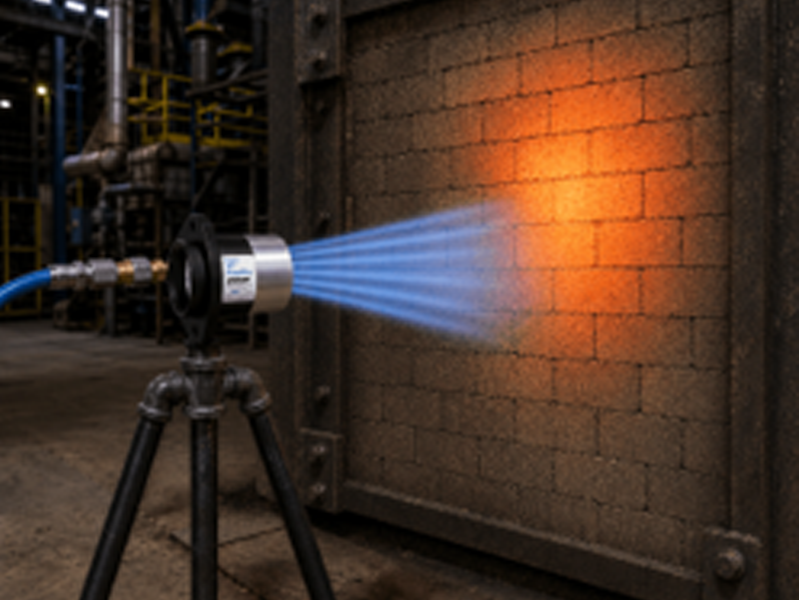
The EXAIR Super Air Amplifier uses a small volume of compressed air to entrain and accelerate large quantities of ambient air. The resulting high‑velocity stream is directed at the refractory surface, rapidly removing heat without physical contact.
Key advantages include:
- Non‑contact cooling that avoids mechanical disturbance
- High‑volume airflow for fast thermal reduction
- Precise targeting of localized hot spots
- No water, no quench shock, no contamination risk
By lowering peak temperatures and smoothing thermal gradients, the Air Amplifier reduces stress concentrations that drive premature refractory failure.
Operational Impact and Economic Value
Even modest extensions in refractory life can deliver substantial financial benefits. Improved hot‑spot management supports:
- Longer campaign duration
- Fewer emergency shutdowns
- Deferred reline costs
- More predictable maintenance planning
- Increased production continuity
For many facilities, these gains translate into thousands of dollars saved through avoided downtime and reduced maintenance interventions.
Conclusion
The EXAIR Super Air Amplifier offers a practical, low‑maintenance method for mitigating refractory hot‑spot damage. Its ability to deliver targeted, non‑contact cooling makes it a valuable addition to standard furnace‑monitoring protocols.
For operations where hot spots routinely shorten lining life, air‑amplification cooling represents a simple upgrade with significant operational impact.
Terri Carlson
ETEST
Tel. +27 82 781 8557
terri@etest.co.za