Food product recalls continue to be a major challenge for manufacturers, with recent data showing an alarming 80% increase in recall incidents over the past year.
With no indication that this trend will slow down, manufacturers are under growing pressure to reduce risk, protect brand integrity, and ensure consistent production reliability.
Most food recalls are linked to unlisted ingredients, particularly allergens, but bacterial contamination, metal detection failures, and other foreign bodies remain persistent risks. At the same time, modern manufacturing practices are adding complexity.
Shorter production runs, a growing number of product variants, frequent reformulations, and regular packaging redesigns all increase the likelihood of labelling and packaging errors.
These realities make process vigilance non-negotiable. Accurate labelling, across both pre-printed elements and variable data such as best-before dates, is critical to ensuring that what’s printed on the pack matches the product inside.
Retailer and third-party standards further raise the bar, with increasingly strict requirements for offline testing, inline inspection, and contaminant detection.
Keeping up with these evolving standards requires smarter, more adaptable inspection and traceability solutions.
To address these challenges, Digimarc and OMRON have combined their expertise to deliver an advanced traceability solution that merges digital watermarking with industrial automation.
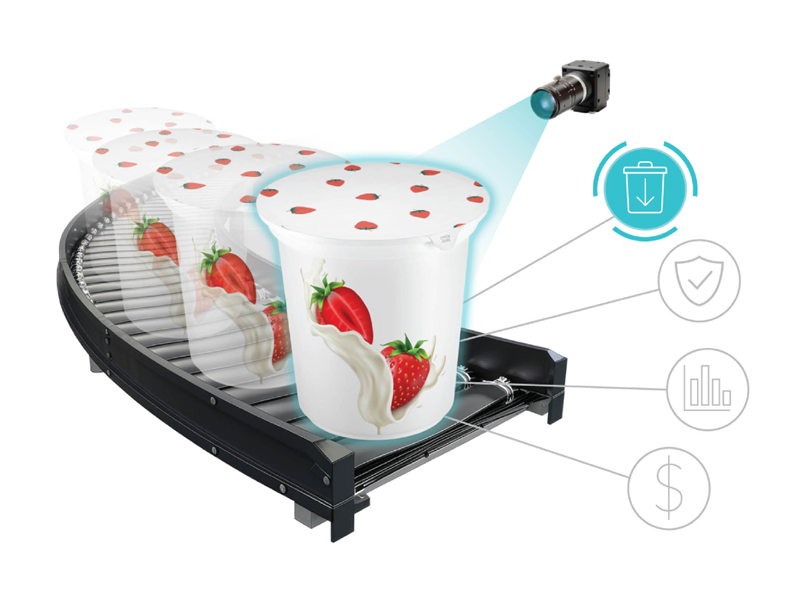
By integrating Digimarc’s imperceptible digital watermark technology with OMRON’s FH Vision System and FHV7 Smart Camera, manufacturers gain the ability to perform fast, accurate product identification and verification even in demanding, high-speed production environments.
Unlike traditional codes such as QR or DataMatrix, which rely on visibility and correct orientation, digital watermarks embed machine-readable data invisibly across the entire packaging surface.
This allows for reliable detection regardless of orientation, lighting, or material type.
Watermarks can be read on challenging surfaces such as cylindrical containers, transparent films, and reflective materials, maintaining consistency even at high line speeds.
This capability significantly strengthens automated quality control. Digital watermarks help ensure that the correct product is paired with the correct packaging, reducing dependence on manual inspections and lowering the risk of costly recalls particularly in high-risk areas such as allergen labelling.
Powered by OMRON’s vision technology, these systems detect and decode watermarks with exceptional accuracy, preserving production integrity without slowing throughput.
Beyond quality and traceability, digital watermarking also supports sustainability goals. By removing the need for additional labelling components like plastic shrink sleeves, manufacturers can reduce material usage and carbon emissions.
In one real-world example, a food producer replaced plastic sleeves with foil lids embedded with digital watermarks, eliminating eight tonnes of single-use plastic from its operations each year.
The benefits extend into downstream operations as well. Because digital watermarks remain readable at high speeds, they improve order fulfilment, sorting, packing, and shipping efficiency. They also support post-consumer recycling by enabling facilities to identify packaging materials.
Digital watermarking also unlocks valuable production data. Real-time insights generated through watermark scanning enable better decision-making across inventory management, quality assurance, and production planning.
This data-driven visibility helps reduce downtime, prevent overproduction, and ensure full end-to-end traceability.
In practice, OMRON’s FH Vision System has demonstrated its versatility in real production environments.
Using colour cameras, one manufacturer successfully detected digital watermarks on foil lids while simultaneously inspecting date codes, checking lid concentricity, and verifying correct alignment.
Operating at speeds of up to 800 parts per minute, the system delivered consistent results and integrated seamlessly into the existing line.
More broadly, vision systems play a critical role in reducing the likelihood and impact of food product recalls.
Solutions such as those offered by OMRON verify codes, graphics, packaging components, label presence, print quality, colour, shape, and optical character recognition (OCR) at full production speed.
When connected to central databases, these systems support comprehensive traceability, regulatory compliance and trend analysis, enabling predictive and preventative maintenance before failures occur.
Monitoring parameters such as temperature trends in primary pack sealing, for example, is essential for maintaining seal integrity and extending shelf life.
While concerns around upfront investment persist, attitudes toward vision technology are shifting.
More manufacturers and machine builders are recognising that the gains in accuracy, reliability, and data integration far outweigh the initial costs.
As recalls become more frequent and more expensive, automation is increasingly viewed not as a luxury, but as a necessity.
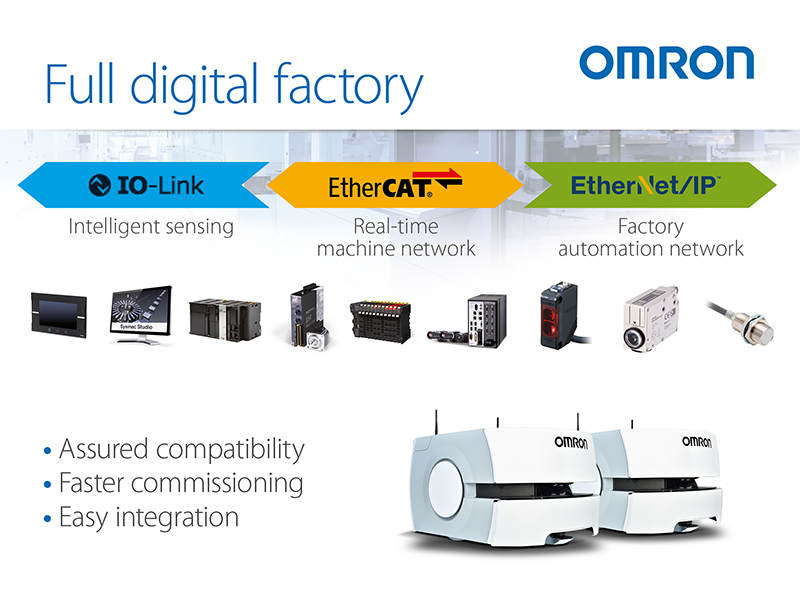
Modern machine controllers now allow logic, motion, vision, safety, and robotics to be unified within a single platform, creating seamless connectivity across the production process.
As the food industry follows the pharmaceutical sector toward higher levels of automation, solutions like the Digimarc–OMRON partnership offer a clear path to improved traceability, reduced waste, and more resilient, future-ready manufacturing.
Cezanne Gonsior
Omron Electronics (Pty) Ltd
Tel: +27 76 062 8668
Cezanne.gonsior@omron.com
www.industrial.omron.co.za