Imagine a future where the wealth extracted from Africa’s mines enriches not just economies but also the environment. This vision of sustainable mining hinges on tackling a critical challenge: water management.
The mining industry, a backbone of economies across Sub-Saharan Africa, faces significant environmental challenges, with wastewater management and dewatering being the most pressing ones.
Mines are major water users, and mine wastewater is laden with pollutants like heavy metals and acid. This acidic water, if not properly managed, can seep into groundwater and devastate ecosystems for generations.
The statistics reveal a concerning reality: numerous mining operations in Sub-Saharan Africa do not have effective wastewater management plans. As a result, millions of litres of untreated wastewater are seeping and leaking, posing a potential risk of contaminating essential water sources.
Using global data from the U.S. Geological Survey (USGS) and WRI’s Aqueduct tool, at least 16% of the world’s land-based critical mineral mines, deposits and districts are located in areas already facing high or extremely high levels of water stress.
The mining industry’s struggle with water management goes beyond technical and economic challenges. A review of mining cases by the World Bank Group’s Compliance Advisor Ombudsman (CAO) underscores that water often triggers conflicts.
The social and environmental implications of water significantly impact mining operations. Communities near mining sites frequently protest against water contamination, which affects their health, agriculture, and livelihoods. This tension sometimes leads to operational delays and financial losses for mining companies.
As a result of strict environmental regulations and lender demands, mining companies are being compelled to reassess their water management practices, leading to the formulation of corporate-level strategies for the first time.
There is hope.
In Ghana, mines have begun collaborative projects to build modern wastewater treatment facilities. These initiatives not only aim to reduce environmental impact but also foster better community relations and sustainable development.
By implementing comprehensive water management plans, mines can significantly reduce their environmental footprint while ensuring the long-term availability of clean water for surrounding communities.
Mines have access to innovative technology to tackle this issue. Advanced level and pressure measurement technologies are vital for the future of water in Africa. Think about the intricate network of pipes and vessels used for transporting and storing mine wastewater—accurate level and pressure measurements are incredibly important in this context.
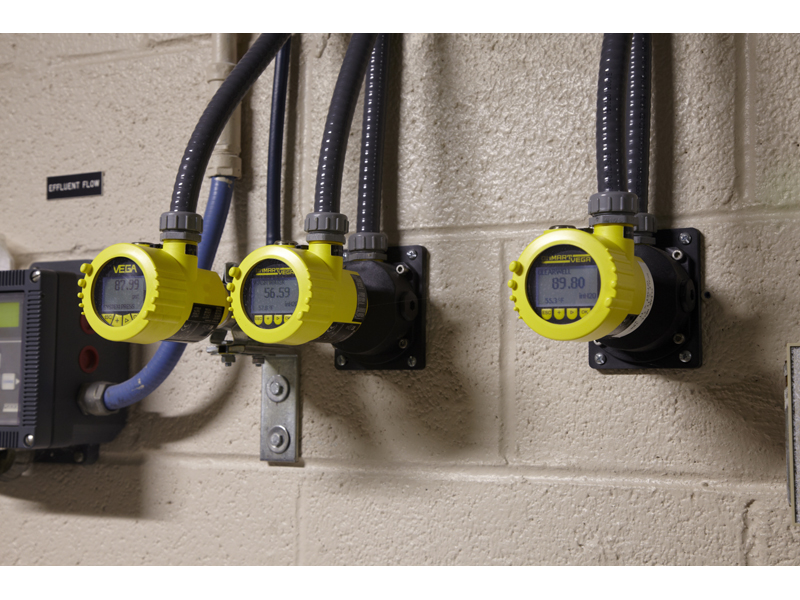
VEGA has introduced robust instrumentation to meet this demand. The company has been working closely with mines in Sub-Saharan Africa for over twenty years, providing reliable, customised solutions built on trust. VEGA sensors are essential for monitoring liquid levels, pressure, and density in mining processes.
Three of the most used instruments in VEGA’s range for water management are the VEGAPULS 6X, VEGAWELL 52, and VEGASWING 63.
The VEGAPULS 6X is a radar sensor used in water management in mines to provide accurate and reliable level measurement of water and wastewater. Its applications include monitoring water levels in reservoirs, tailings ponds, and water treatment plants.
The VEGAPULS 6X ensures precise water level data, which is crucial for efficient water usage, preventing overflow, and managing water resources effectively. Its non-contact measurement technology is ideal for harsh mining environments, as it is unaffected by dust, mud, or changing weather conditions.
This helps maintain continuous operation and supports overall water management strategies in mining operations.
The VEGAWELL 52 is a hydrostatic submersible pressure transmitter that ensures operational efficiency by delivering real-time pressure data. Accurate pressure measurement is crucial for controlling processes, particularly in the dewatering of wells in open-cast mining.
Lowering the water table with dewatering wells helps maintain stable pit walls and reduces the risk of collapses that could pollute nearby waterways. Additionally, collected mine water can be treated to minimise contamination of surrounding groundwater sources.
However, dewatering wells present challenges such as continuous pump operation leading to sediment build-up and equipment failure. The solution lies in maintaining a continuous water flow, which prevents pump blockages.
The VEGAWELL 52 excels in this aspect with its accurate level measurement, robust design, and abrasion-resistant CERTEC® ceramic measuring cell, making it ideal for deep wells.
Its precise and maintenance-free measurements optimise pump operation, reducing energy consumption and pump operating costs, thus promoting an environmentally friendly and efficient approach to dewatering systems in mining operations.
At a copper mine in the Democratic Republic of Congo, the VEGASWING 63 tuning fork level switch regulates water levels in columns containing acidic scrub water with a pH of 11. These sensors prevent overfill and dry run scenarios, ensuring an uninterrupted flow to subsequent production stages.
Mounted to the side of the tank, the vibrating fork responds sensitively to liquid level changes, triggering actions to prevent overfilling and dry running. When the liquid level reaches the high-level setpoint, the sensor activates a pump to stop filling the tank.
Conversely, when the level drops to the low-level setpoint, the sensor signals to refill the tank or shut down equipment to prevent damage. Its real-time detection of water level changes and reliable operation in corrosive environments make it a crucial component in maintaining the efficiency and safety of mining processes.
The VEGASWING 63’s reliability in harsh, corrosive environments makes it ideal for mining processes involving acidic water. It integrates seamlessly into mining operations’ control systems, automating and efficiently controlling liquid levels.
VEGA’s solutions significantly mitigate the environmental effects of mining operations. The use of VEGA sensors in mining operations ensures that the mines maintain consistent processes, which is crucial for operational efficiency and safety, especially when dealing with acidic water.
This success story demonstrates how VEGA’s technology can transform mining operations seeking to balance productivity with environmental responsibility. By adopting these solutions, mines in Sub-Saharan Africa can pursue true sustainability, minimising environmental risks, preserving water resources, and contributing to healthier communities in the future.
The potential for success doesn’t just come from mining minerals but from the responsible use of the resources involved in the extraction process. Can Sub-Saharan Africa transition to a sustainable mining future? Absolutely, with the assistance of VEGA, they can make it happen.
Miguel Petersen
Vega Controls SA (Pty) Ltd
Tel. +27 11 795 3249
miguel.petersen@vega.com
www.vega.com