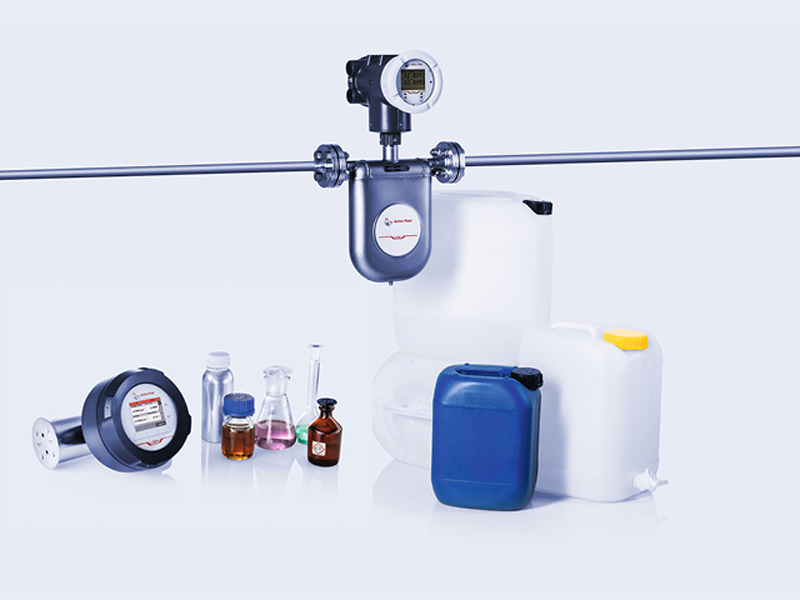
In the dynamic field of bioethanol production, the precision of inline measurement methods is crucial for efficiency, quality, and compliance. This report focuses on mass flow, density and concentration measurements using the L-Cor 8000 flowmeter and the L-Dens 7500 density meter, essential for optimizing key stages in the production process.
Accurate measurements are vital as bioethanol, a sustainable fuel, gains more and more importance in the market.
Process overview
In bioethanol production, there are two different ways to obtain ethanol, which vary depending on the country and the availability of raw materials. Either you use corn, barley or wheat as raw materials and then process them further or you use sugar juice from sugar cane or sugar beet from sugar factories and produce ethanol from it.
These two processes through to fermentation are different and therefore have different requirements.
Processing of corn
In a first step, the corn is processed in a hammer mill into a fine powder known as meal. The meal will then be mixed with water and enzymes and will pass through cookers where the starch is liquefied.
The most important aspect of this process is the conversion of starch into long-chain sugar, as this maximizes the ethanol yield in the subsequent fermentation.
The ideal conversion depends on both the solids content of the mash and the quantity of enzymes. To ensure the optimum mixing ratio, accurate measurement of the solids content is crucial.
The L-Cor 8000 Coriolis flow meter from Anton Paar determines the concentration via the density and thus increases the efficiency of the fermentation process. Finally, yeast is added to ferment the sugar into ethanol and carbon dioxide just before fermentation.
Processing of sugar cane
Sugar cane is used as an alternative raw material, which then is used as juice for fermentation after processing in a sugar factory.
From fermentation to bioethanol
Once fermentation has been started, the process of producing ethanol from corn and sugar cane is the same. During the long fermentation period, the mash is converted into ethanol (C2H5OH).
Ensuring that fermentation is completed on time is crucial for process efficiency. The use of Anton Paar’s high-precision L-Cor 8000 enables effortless monitoring of the density drop during fermentation and thus the exact determination of the end point of fermentation.
This not only optimizes time utilization, but also reveals deviations in the fermentation process.
Afterwards, the mixture is heated again in the distillation column until the ethanol begins to condense, separating it from the residual liquid, the so-called stillage.
The distillation process is already sufficient for the production of 96 % ethanol (180 proof). To ensure continuous product quality, it is best to monitor the concentration of ethanol using the L-Dens 7500 density meter with an accuracy of up to 0.02 %w/w.
Additionally, if you want to achieve 99.9 %w/w ethanol (200 Proof), the bioethanol-water mixture is purified to achieve the required degree of purity.
Processes such as drying or the use of a molecular sieve help to remove water or impurities. Continuous monitoring is required to maintain the desired ethanol concentration in the end product.
Anton Paar’s L-Dens 7500 density sensor is ideally suited for this purpose. In combination with a customized formula for the ethanol concentration, it provides unparalleled accuracy and thus ensures highest product quality.
Upon completion of the production cycle, the ethanol is readied for distribution and uploading. Charging is conducted based on weight, wherein the L-Cor 8000 Coriolis mass flow meter offers remarkable reliability.
The flowmeter is OIML-certified and offers an exceptional accuracy of 0.1 % in mass flow.
Hence, the flowmeter is well-suited for custody transfer applications, ensuring no regulatory issues arise.
The produced ethanol finds diverse applications, including blending with gasoline (e.g., E05, E10, or E85) for use as a fuel additive. These designations denote the respective ethanol content proportions in the blend, thereby offering consumers varied options tailored to their requirements.
Process solutions – Density and flow sensor
Anton Paar’s high-precision process measuring instruments enable you to optimize your process in every respect and get the most out of your resources. This not only saves time and money, but also energy.
The Coriolis mass flowmeter L-Cor 8000 has the highest mass flow accuracy of 0.1 %. It boasts the highest Ex classification as well, making it suitable for almost every application.
If even the slightest difference in density makes a significant financial impact, then the L-Dens 7500 steps in with unmatched accuracy of 0.00005 g/cm³.
Your benefits at a glance
- Save time, money and energy with highprecision inline density measurement
- OIML certified sensors according to WELMEC
- Easy integration and maintenance free design
- Multiparameter measurement
- Highest density & mass flow accuracy
- Fit and forget solution
Further Anton Paar solutions
DMA: Use a DMA density meter as lab reference for density. As an accredited laboratory, Anton Paar GmbH offers ISO 17025 calibration of laboratory density meter for most precise results to guarantee traceability to the International System of Units (SI).
Wiaan Goosen
Anton Paar Southern Africa
Tel. +27 82 651 2308
wiaan.goosen@anton-paar.com
https://www.anton-paar.com/za-en/