The main sugar beet growing areas are in the temperate regions of Europe and North America, with average heat wave temperatures between 16-25 ° C and annual rainfall of at least 600 mm. Before the beet is processed, it is stacked in huge mountains outside.
Although the mountain hold the beets well, those on the inside of the pile are more affected by heat and moisture to the point of damage.
Challenge
The customer is a major Spanish sugar manufacturer that wanted to implement a system to control and monitor its beet mountains. It detected that the beets in the lower centre of the mountain were spoiling before being removed to start the sugar conversion process.
As a result, a percentage of the raw material was being discarded, losing significant amounts of money at the end of the year.
He was looking for a system to detect when the beets were about to rot, to prevent it and extract them in time. The system had to be outdoors, so it would have to withstand possible weather adversities.
Conclusion
To solve the problem, the customer opted for a system that uses Industrial Shields devices to monitor temperature and humidity inside the mountains.
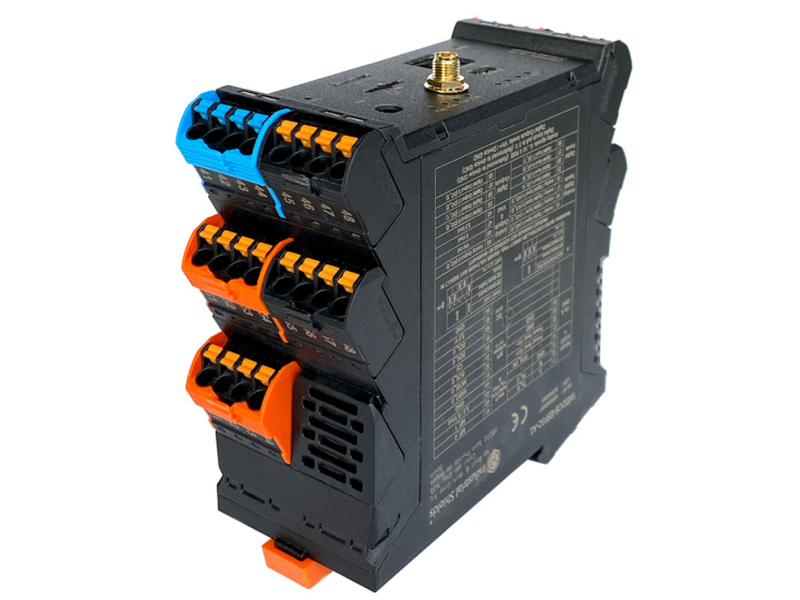
On each mountain, a WIS PLC connected to the corresponding sensors is implemented, which sends the collected data to another one that acts as a master.
All data collected by the master is redirected to a Raspberry PLC, which sends it to a server via Ethernet or Wi-Fi.
It is essential to monitor temperature and humidity to know if the beets are in good condition or have started to root. If a high level of heat and humidity is detected, a warning signal is sent.
Since the beets are removed with bulldozers, the sensors must be buried underground avoiding the bulldozer blades, but maintaining the ability to detect the beets. The WIS PLC will use a DS18B20 sensor to detect weather information.
The WIS PLC is located outside the mountain, inside an electrical box, while the sensor, as mentioned before, is buried under the mountain, at a depth of 15m.
Since beets do not root in a matter of minutes, a signal “wakes up” the IoT PLC every hour to send the actual data to the master via radio frequency; they can operate using a 2.4 GHz signal (less distance but better data rate) or an 868 MHz signal (more distance but worse data rate).
The WIS PLC master is located near the factory, connected to a Raspberry PLC through a USB port. The PLC sends all information to an internal database, or directly to the cloud via Ethernet or Wi-Fi.
In the near future, a beacon could be added to the electrical boxes where the WIS PLCs are located, for a visual alert when levels exceed limits and will allow them to be easily seen.
Calvin Brown
Ganar Group
Tel. +27 63 527 9870
calvin@ganargroup.co.za
https://ganar-automation.ganargroup.co.za/